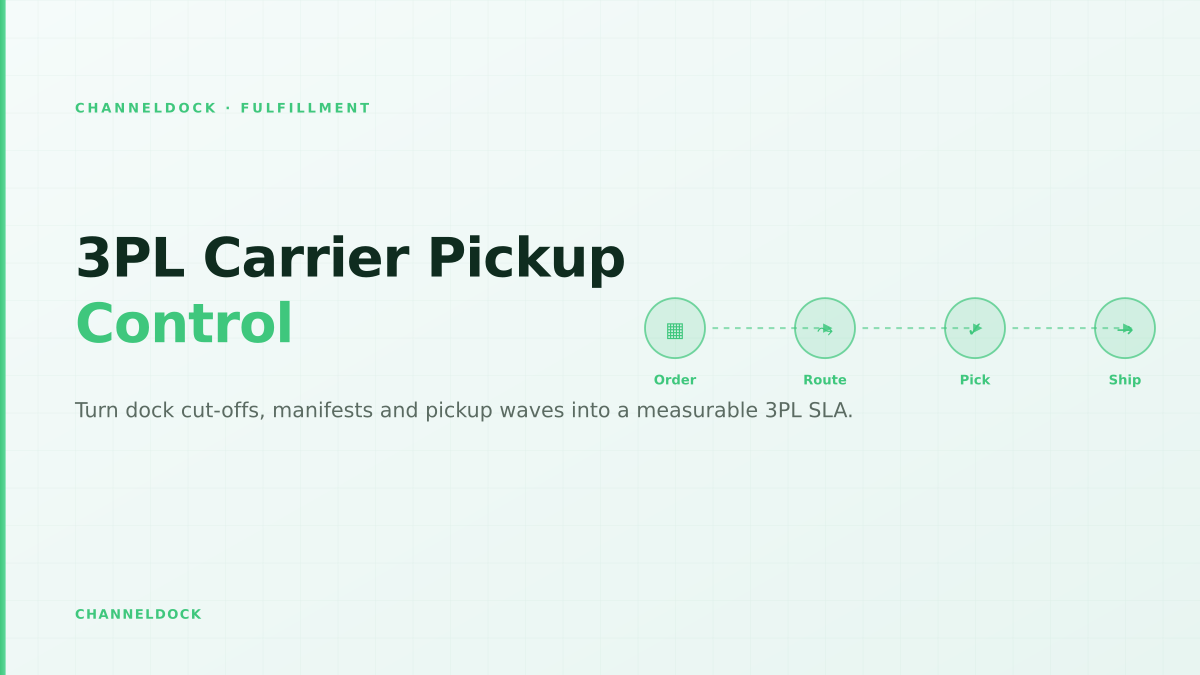
3PL Carrier Pickup Management: Stop Missing the Cut-Off
In July 2026, the clearest operational pattern in 3PL search results is not “more carriers” or “cheaper labels.” It is the clock. Shopify tells merchants to know the cut-off time of the main carrier and plan around it. Amazon’s seller settings describe order cut-off as a value that should sit 30 minutes before carrier pickup. ShipHero support uses the same practical buffer for carrier-account cut-offs. For a fulfillment center, that 30-minute gap is not trivia; it is the difference between a clean same-day SLA and a truck leaving while 140 labelled parcels still sit at packing.
Most ranking articles explain what a 3PL does, how same-day shipping works, or why manifests matter. Very few connect the whole operating chain: marketplace order intake, pick wave release, packing capacity, manifest close-out, dock staging, carrier arrival and client SLA proof. That is the gap this playbook fills for ecommerce fulfillment centers using fulfillment software, 3PL collaboration workflows and barcode-driven warehouse execution.
Carrier pickup is the real end of the fulfillment day
Warehouse teams often talk about the day ending when the last order is packed. Clients talk about it ending when tracking updates. Carriers think in pickup windows. The 3PL has to reconcile all three. If a parcel misses the pickup, the customer does not care that it was picked accurately, packed neatly and labelled at 16:58. It still missed the network injection point.
That is why 3PL carrier pickup management should be treated as a WMS workflow, not an afterthought in the shipping tool. The handover depends on every upstream step: whether the order reached the warehouse in time, whether SKU locations were clean, whether the pack bench printed the correct carrier label, whether customs data was complete, and whether the manifest was closed before the driver needed to scan.
The problem with one warehouse-wide cut-off
A single 14:00 same-day cut-off is easy for sales pages and client contracts, but fulfillment centers rarely run one simple outbound stream. One client may ship domestic parcels with PostNL, another may use DHL for Germany, a third may need pallet pickup, and a fourth may have marketplace orders from Amazon, bol.com, Zalando or Kaufland with different expectations. During peak season, one truck delay can turn the shared dock into a negotiation between clients.
The better model is to publish a client-facing promise but operate a more granular internal plan: cut-off by carrier, service level, warehouse zone and exception type. A 12:00 pallet wave and a 15:30 parcel wave can both support “same-day” in different ways. The WMS should make that visible instead of forcing supervisors to remember it from a whiteboard.
A late pickup is rarely just a carrier issue. In a 3PL warehouse it usually starts earlier: orders released too close to cut-off, labels printed after the truck is staged, manifests closed too late, or client exceptions mixed into the same outbound lane.
A practical pickup-control workflow for 3PLs
The strongest 3PLs work backwards from the truck. They do not ask, “How late can we accept orders?” They ask, “What must be true 30, 60 and 120 minutes before each carrier leaves?” The answer becomes an operating rhythm that can be measured every day.
- 1Map every carrier promise backwards from the truckStart with the real pickup time per carrier, service and warehouse door. Then subtract manifest close, staging, packing and pick-wave time. The customer-facing cut-off is the result, not the starting point.
- 2Split outbound into pickup wavesCreate a wave per carrier and service level: PostNL parcels, DHL parcels, DPD, pallet/LTL and marketplace-specific lanes. Each wave gets its own cut-off and owner.
- 3Close manifests before the dock gets crowdedTreat manifest close-out as an operational gate. If labels are still being created while the driver is waiting, the system has not protected the SLA.
- 4Stage by carrier, client and exception statusReady-to-load shipments should not sit beside address fixes, customs holds or client approvals. Exceptions need a visible lane so they do not contaminate the clean pickup.
- 5Report SLA proof back to clientsStore timestamps for pick complete, pack complete, label print, manifest close and carrier handover. Client discussions become evidence-based instead of email archaeology.
What competitors often miss
Competitor content from ShipStation, ShipHero, Shipium, Logiwa and Extensiv is useful, but it usually covers one layer: how to create a manifest, how carrier accounts work, how multi-carrier shipping improves rate selection, or what same-day fulfillment means for brands. The fulfillment-center gap is cross-client control. A 3PL does not just need to print labels; it needs to prove that client A’s 15:00 promise did not get delayed by client B’s address errors or client C’s late marketplace import.
This is where pick and pack execution and channel integrations matter. If orders from Shopify, WooCommerce, Amazon, bol.com and a B2B portal arrive in one queue but the dock is planned in another system, the cut-off becomes guesswork. The software should connect order source, SKU status, carrier service, batch, manifest and handover timestamp.
Manual pickup control
- One shared spreadsheet for cut-offs
- Labels printed until the driver arrives
- Exceptions discovered at the dock
- Client SLA disputes handled by email
ChannelDock-style dock controlRecommended
- Pickup waves tied to carrier cut-offs
- Barcode-driven status before staging
- Carrier and client exceptions separated
- SLA timestamps visible in the workflow
The metrics that make pickup management visible
Carrier pickup performance should not be reported as “we shipped everything we could.” A serious fulfillment operation needs a small set of daily numbers that separate warehouse execution from carrier behaviour. Start with cut-off compliance: orders accepted before cut-off that reached carrier handover on time. Then track manifest close time, shipments rolled to next day, exception count by reason, carrier arrival variance and client-level SLA misses.
The useful insight is not the average. It is the pattern. If DHL Germany misses are concentrated on Mondays, the issue may be weekend order import and pick-wave size. If one client causes most address holds, the fix may be validation at order intake. If labels print on time but manifests close late, the dock process needs a separate owner. These are the signals that turn pickup management from firefighting into capacity planning.
A 3PL does not win same-day shipping by promising a later cut-off. It wins by proving that every order accepted before cut-off has a clean path to the carrier scan.
How to use ChannelDock in the pickup-control layer
ChannelDock is strongest when a fulfillment center needs connected operational visibility: orders from multiple ecommerce channels, stock locations, pick and pack steps, shipping labels, client collaboration and fulfillment-center analytics. For pickup management, that means the team can separate ready orders from exceptions before the truck arrives, keep client-specific flows visible, and use carrier labels and fulfillment statuses as part of one workflow instead of separate end-of-day exports.
The practical starting point is simple: define carrier waves inside the warehouse routine, connect each wave to the order sources that feed it, and make exception reasons visible before packing. Once that rhythm is stable, a 3PL can extend client promises with evidence instead of optimism.
- Do not promise a later same-day cut-off until the dock, manifest and staffing plan support it.
- A 30-minute manifest buffer is a practical minimum; peak season often needs more.
- Carrier pickup management belongs inside the WMS workflow, not in a separate end-of-day checklist.
- Clients trust the 3PL more when SLA proof is visible: timestamps, manifests, scans and exception reasons.
FAQ
What is 3PL carrier pickup management?
How much buffer should a fulfillment center keep before pickup?
Should a 3PL use one daily cut-off for every client?
What causes most missed carrier pickups?
How does ChannelDock help with pickup control?
Conclusion
3PL carrier pickup management is where warehouse execution becomes customer experience. The order may be imported, picked, packed and labelled, but it only becomes a kept promise when it reaches the carrier on time with the right manifest and the right proof. Fulfillment centers that control this layer can offer later cut-offs, cleaner client reporting and fewer “where is my shipment?” escalations without turning every afternoon into dock chaos.
For ecommerce 3PLs, the next software step is not another isolated shipping tool. It is a connected workflow where marketplace orders, barcode execution, manifests, carrier pickups and client SLAs live together.