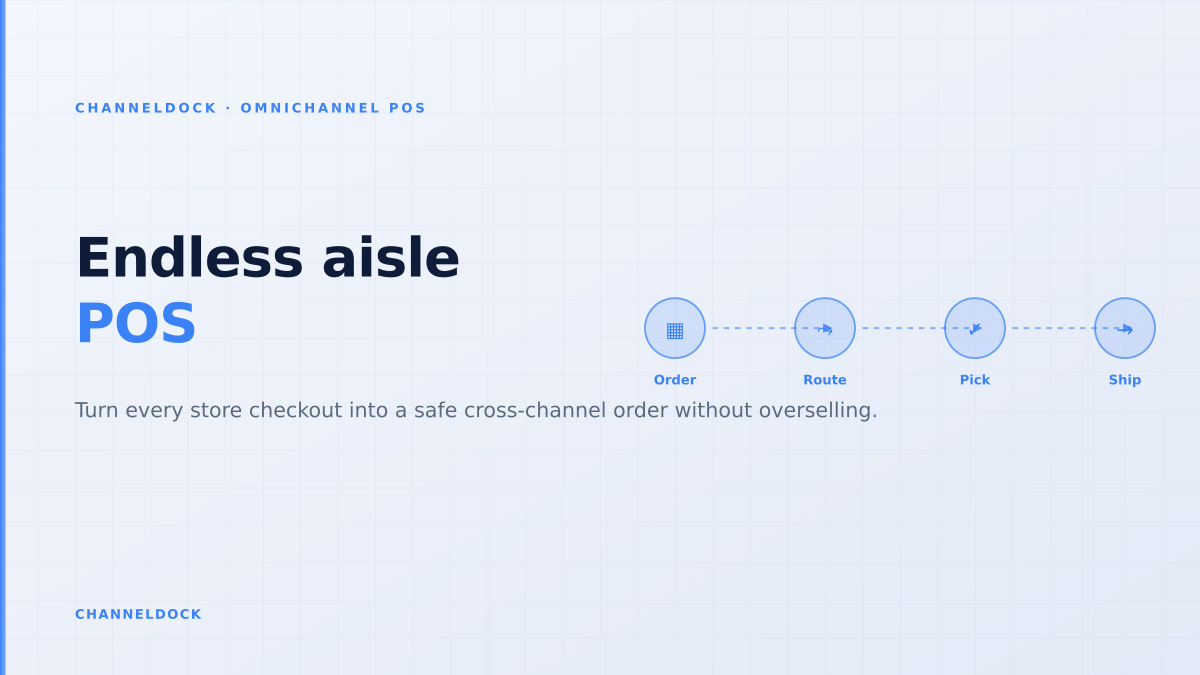
Endless Aisle POS Inventory: Save Store Sales Safely
Endless aisle is having a 2026 comeback because retailers are tired of losing high-intent store visitors when the right size, colour or bundle is not on the shelf. Shopify's 2026 guide describes endless aisle as an in-store order that can ship from another store, a warehouse or directly to the customer; Lightspeed frames it as a way to merge physical shopping with a deeper online catalogue. Both are right, but both descriptions skip the operational question that decides whether the model works: can the POS make a safe inventory promise in real time?
For omnichannel retailers, that promise is harder than it sounds. A pair of shoes may be physically in a warehouse, reserved for Amazon, waiting in a pick wave, blocked after a return inspection, or already committed to a B2B order. If a store associate sees only raw stock, endless aisle becomes another overselling channel. If the POS sees a clean sellable-stock number from the same source that feeds marketplaces and the webshop, endless aisle becomes a practical way to save sales without creating fulfilment debt.
What ranking endless aisle guides usually miss
Most ranking content explains the customer-facing story: wider assortment, fewer walkouts, kiosk ordering and ship-to-customer checkout. Shopify, Lightspeed, Salesforce, NewStore and Adyen all cover these basics well. The gap is the middle layer between the POS screen and the warehouse floor: stock confidence, routing rules, staff permissions, payment timing, fulfilment handoff and exception handling.
That middle layer matters most for retailers who also sell through marketplaces. A store associate might be trying to save a sale while the same SKU is moving on bol.com, Amazon, Zalando, OTTO, Kaufland, Temu or TikTok Shop. ChannelDock's integrations overview and orders feature overview are built around exactly that operational problem: every channel can create demand, but the business still needs one queue, one stock truth and one fulfilment decision.
The safe-stock formula for endless aisle
The first design choice is what the POS is allowed to show. Raw stock is almost never safe enough. A practical endless aisle availability number starts with on-hand stock by location, then subtracts open picks, paid-but-not-fulfilled online orders, marketplace reservations, damaged stock, pending return inspections, store display holds, supplier uncertainty and a small buffer for high-velocity SKUs.
Think of it as an operational version of available-to-sell. The POS does not need to explain the whole formula to the store associate. It simply needs to hide anything that should not be promised and show a clear fulfilment option for what remains: ship from warehouse, transfer to store, ship from another store or reject the promise.
The risky version of endless aisle is letting store staff sell every SKU that appears somewhere in the catalogue. The safer version only exposes inventory that has passed a sellable-stock rule, a fulfilment rule and a channel-priority rule.
A practical endless aisle flow
The cleanest flow is not 'browse catalogue, take payment, hope fulfilment works'. It is a short sequence that tests the promise before the customer commits. The associate should see product variants, fulfilment locations, delivery options and any margin-impacting rule before checkout.
- 1Expose only promise-safe stockStart with available-to-sell stock, not raw on-hand stock. Remove damaged units, pending returns, cycle-count holds, marketplace reservations and transfer quantities.
- 2Route before payment captureDecide whether the order should ship from a warehouse, another store or a supplier before the associate promises a date to the customer.
- 3Create one order eventThe POS order should enter the same operational inbox as webshop, bol.com, Amazon, Zalando, OTTO, Kaufland, Temu and TikTok Shop orders.
- 4Give staff exception scriptsIf stock disappears between lookup and fulfilment, staff need a clear substitution, transfer or refund workflow instead of a manual note.
This is where an ecommerce operations layer is more useful than a POS-only feature. ChannelDock can sit beside the POS system and connect store-originated orders to the same stock, order and shipping workflows used by the webshop and marketplaces. Retailers can then use inventory controls, warehouse fulfilment and carrier execution instead of managing endless aisle exceptions in a separate spreadsheet.
Catalogue-first versus operations-first endless aisle
There are two versions of endless aisle. The first is catalogue-first: show more products and make the store feel bigger. The second is operations-first: show only what the business can fulfil profitably and on time. The second version is less flashy, but it is the one that survives peak season.
Catalogue-first endless aisle
- Shows every online SKU in the store
- Looks impressive during the demo
- Creates oversell risk when stock is already reserved
- Exceptions land in email or spreadsheets
Operations-first endless aisleRecommended
- Shows only sellable, routable stock
- Checks warehouse and store availability in real time
- Pushes every sale into the same order queue
- Measures saved sales and failed promises separately
Five failure modes to design out before launch
Endless aisle fails quietly at first. The store team saves a sale, the warehouse cannot find the item, customer service edits the order manually, the refund is booked against the wrong channel, and nobody measures it as an endless aisle failure. By the time the pattern is visible, staff have already stopped trusting the POS stock screen.
- Split stock truths: the POS, webshop and marketplace connector each calculate availability differently.
- Late routing: payment is captured before the fulfilment location is selected and checked.
- No marketplace buffer: fast-moving SKUs are sold in-store while marketplace orders are still importing.
- Weak exception ownership: store staff, warehouse staff and customer service all assume another team will fix failed promises.
- Margin blindness: saved revenue is celebrated even when shipping, transfer or split-fulfilment cost eats the profit.
Endless aisle should be measured as an inventory-promise system, not a catalogue-expansion project. If the promise fails, the customer remembers the store visit, not the integration architecture.
What to measure after go-live
Revenue matters, but it is not enough. A retailer can grow endless aisle revenue while also growing manual corrections, late shipments and marketplace stockouts. The dashboard should separate saved sales from failed promises and should show where the promise broke.
- Saved-sale rate: number of endless aisle orders divided by out-of-stock assisted selling moments.
- Promise failure rate: orders that needed substitution, cancellation, manual reroute or refund after checkout.
- Time to release: minutes from POS checkout to fulfilment queue visibility.
- Location accuracy: percentage of promised units found at the selected fulfilment node.
- Net margin after fulfilment: revenue minus payment fees, shipping, transfer cost and manual labour.
- Endless aisle is not just a kiosk or a POS screen; it is an inventory promise made in front of the customer.
- Raw on-hand stock is too optimistic when online orders, marketplace reservations, transfers and returns are also moving.
- The best KPI is not endless aisle revenue alone. Track failed promises, manual fixes and margin after shipping.
- ChannelDock fits as the operational layer that connects POS, online orders, warehouse stock and marketplace availability.
FAQ
What is endless aisle POS inventory?
How is endless aisle different from BOPIS or ship-from-store?
Which systems need to connect for endless aisle to work?
Why do endless aisle projects create overselling?
Where does ChannelDock fit in an endless aisle setup?
Conclusion
Endless aisle is a strong omnichannel POS play when it is built on reliable inventory and a real fulfilment handoff. It lets retailers keep the in-store conversation alive, sell warehouse or long-tail stock, and give shoppers delivery options without forcing every variant onto every shelf.
The operational standard is simple: if the POS cannot prove the stock is sellable, routable and protected from marketplace conflict, it should not promise it. ChannelDock helps retailers make that standard practical by connecting POS, ecommerce, marketplaces, inventory and warehouse execution in one operational flow. That is what turns endless aisle from a nice retail feature into a safe revenue channel.