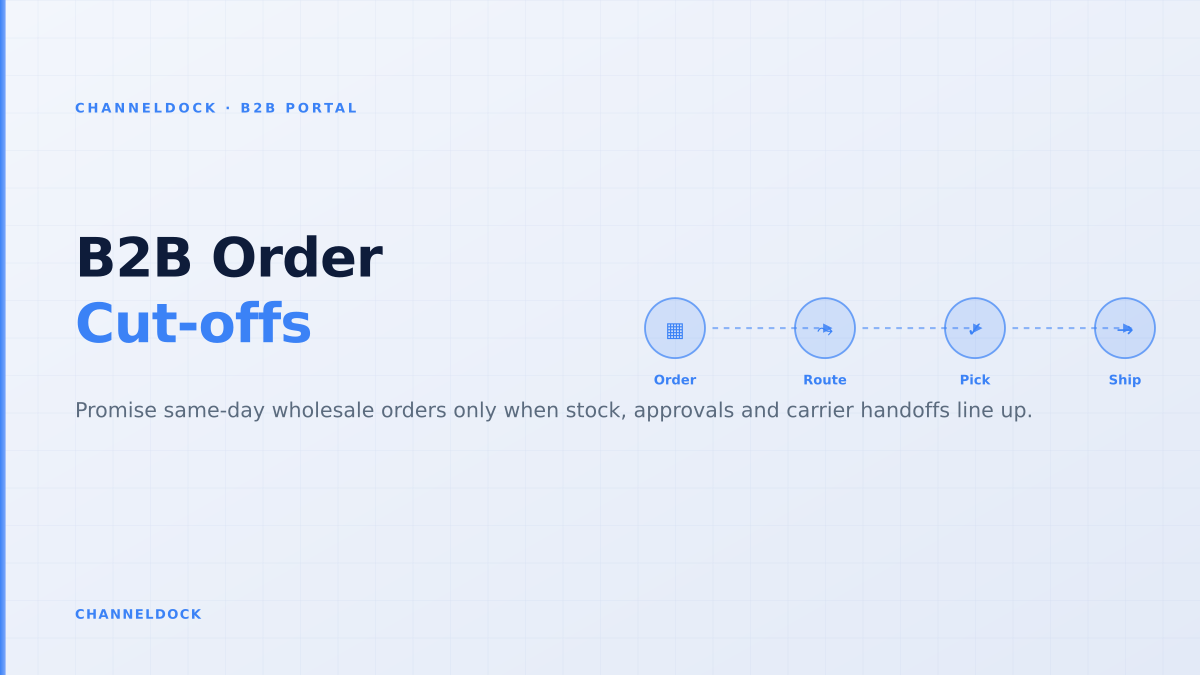
B2B Order Cut-Off Times: Wholesale Portal Rules
In August 2026, the strongest B2B portal content still repeats the same promise: buyers can order 24/7, see their own prices and track their order history. That is useful, but it leaves out the operational question wholesalers feel every afternoon: which orders can still ship today without breaking the warehouse?
Published fulfillment SLAs show why the question matters. ShipBob lists B2B, FBA and work-order cut-offs around 12:00 local time in several regions, and Flexport’s seller-portal SLA says B2B and wholesale orders must be submitted by 12 PM local time to start same-day processing. Meanwhile, B2B exception benchmarks often put 20–40% of orders into some kind of manual review. The gap between those numbers is where margin, trust and OTIF disappear.
A B2B portal should therefore do more than accept a cart. It should decide whether the promise shown to the buyer is still operationally true: is the stock available, is the buyer allowed to order, are approval and credit rules clear, can the order enter the next pick wave, and can the parcel, pallet or freight handoff still happen today?
The real cut-off is not the checkout time
The checkout timestamp is only one checkpoint. In a wholesale workflow, an order may be submitted at 10:30 and still miss the noon operational cut-off if it waits for credit approval, customer-specific price validation, export documents, pallet instructions or a stock substitution. The buyer sees one order; the warehouse sees a sequence of gates.
This is why a static “order before 15:00 for same-day shipping” rule breaks down in B2B. It treats a five-SKU parcel reorder, a mixed-pallet replenishment order and a freight shipment with receiving appointment requirements as the same operational object. They are not. Each has a different critical path through stock reservation, picking, packing, paperwork and carrier handoff.
A later cut-off does not create more warehouse capacity. It only moves risk from the portal to pickers, packers, customer service and the carrier handoff. The safer move is a dynamic promise: show the latest order time only when stock is reservable, approval can clear, and the next pick wave can still reach the dock.
What ranking B2B portal guides usually miss
Competitor pages from Shopify, Salesforce, OroCommerce, BigCommerce, WizCommerce and specialist B2B portal vendors are strong on the front-end buyer experience: login-gated catalogs, negotiated pricing, bulk order forms, one-click reorder, account roles, invoices and tracking. Those are table stakes. The missing piece is how the portal should translate a buyer action into an order that is safe for the warehouse to release.
For ChannelDock’s audience — wholesalers, distributors and brands running both ecommerce and wholesale operations — that missing layer matters more than another generic portal feature list. A wholesale buyer does not only ask, “Can I order online?” They ask, “Can I rely on this promise for tomorrow’s shelf, route or installation?”
The best-ranking B2B portal articles talk about 24/7 ordering, customer-specific pricing and order history. Very few explain how a wholesale promise survives contact with pick waves, carrier pick-up times, approvals, documents and partial stock. That operational layer is where a portal becomes reliable.
Build the cut-off backwards from the dock
The practical formula is simple: start with the last physical handoff and subtract the work required to get there. If the carrier leaves at 16:00, the last staged shipment may need to be ready by 15:30. If packing and labeling take 45 minutes, picking must finish by 14:45. If picking a mixed B2B order takes 60–90 minutes and documents require review, the portal’s latest safe order release may be closer to noon than to 15:00.
That calculation should live inside the operating rules, not in a PDF the sales team remembers on good days. Connect the portal to order management rules so submitted orders can be tagged as “same-day eligible”, “needs approval”, “stock exception”, “next wave”, or “next business day” before the buyer gets a false expectation.
- 1Start from the carrier and dock, not the storefrontRecord final parcel collection, pallet staging time, LTL appointment rules, and any route-specific handoff deadlines before you decide what the portal can promise.
- 2Subtract real warehouse workReserve time for pick release, barcode picking, packing, label creation, document generation, staging, exception review and a buffer for urgent substitutions.
- 3Split promises by order profileParcel cartons, pallet orders, mixed-case replenishment and customer pickup should not share one cut-off because their warehouse paths are different.
- 4Let approval status change the promiseIf a buyer needs manager approval, credit review or sales validation, the portal should show when the order becomes warehouse-ready, not just when the cart was submitted.
- 5Measure misses by causeSeparate misses caused by late portal submission, insufficient stock, approval delay, pick delay, document delay and carrier handoff. One blended late-order number hides the fix.
Static cut-offs vs operational promises
Wholesalers often start with a single cut-off because it is easy to explain. That is fine in the first phase of a portal launch. But as soon as the business has multiple buyer groups, warehouses, carriers, product classes or approval paths, a static rule becomes a blunt instrument. It either promises too much and creates late orders, or promises too little and leaves revenue on the table.
An operational promise can still be simple for the buyer. The complexity stays behind the scenes: the portal checks inventory, order value, buyer role, credit status, carrier route, warehouse load and shipping method, then displays the next reliable fulfillment window. The buyer sees clarity; the operations team gets a release queue they can actually execute.
Static portal cut-off
- Same promise for every buyer, SKU and warehouse
- Looks commercially attractive until volume spikes
- Late approvals and partial stock become manual exceptions
- Customer service explains delays after checkout
Operational cut-off rulesRecommended
- Promise is calculated from stock, approval status and wave capacity
- Different cut-offs for parcel, pallet, freight and pickup
- Orders after cut-off move automatically to the next promise window
- Buyers see status before they call sales
The order status timeline buyers actually need
Most portal status labels are too broad. “Processing” can mean the order is waiting for approval, missing stock, being picked, waiting for documents, packed but not collected, or already handed to a carrier whose tracking has not synced yet. For B2B buyers, those differences matter because they plan replenishment, staff, shelves and customer commitments around the order.
A better status model mirrors the operational gates: submitted, approved, stock reserved, released to warehouse, picking, packing, documents ready, staged, shipped, partially shipped, backordered and delivered. When these statuses sync through ChannelDock integrations, buyers stop chasing the sales team and customer service can focus on exceptions instead of routine “where is my order?” messages.
- T-1 dayBuyer builds the replenishment cartThe portal shows account-specific prices, live available stock and the next realistic delivery window instead of a generic same-day badge.
- 09:30Approval and stock reservation clearThe order moves from submitted to warehouse-ready. Stock is reserved so another channel cannot consume the same units.
- 11:45Last safe B2B releaseThe system checks whether the order can still enter the noon wave. If not, it offers next-day processing before the buyer confirms.
- 14:30Pick, pack and documents completePacking slip, invoice, pallet labels or delivery note are ready before staging, not chased by customer service after the dock closes.
- 16:00Carrier handoffTracking and order status flow back into the portal so the buyer sees progress without emailing the sales team.
Where B2B cut-off rules usually fail
The first failure is time zone ambiguity. A buyer submits at 11:45, the company headquarters is in one time zone, the warehouse in another, and the portal logs the order in server time. The promise should always use the local time of the warehouse that will ship the order.
The second failure is partial stock. A portal that shows total company stock may promise an order from the wrong location. The right rule is available-to-promise by warehouse, with reserved stock excluded and incoming purchase orders treated as future availability unless receiving has actually happened.
The third failure is document readiness. B2B orders often require packing slips, invoices, delivery notes, pallet labels, customs data, EDI messages or retailer-specific routing instructions. If document creation happens after picking, a “picked” order can still miss the dock.
A B2B portal becomes trustworthy when it refuses to promise what the warehouse cannot release.
How ChannelDock should frame the win
ChannelDock is not trying to replace every ERP, webshop or accounting tool in the wholesale stack. The sharper position is operational: the B2B sales portal gives buyers a controlled self-service surface, while ChannelDock keeps orders, stock, warehouse release, documents and shipping rules in one workflow.
That combination matters for brands that sell to marketplaces, webshops, retailers, dealers and wholesale customers at the same time. If the B2B portal is disconnected, wholesale orders compete with marketplace orders invisibly. If it is connected to inventory and fulfillment rules, the team can decide which stock is sellable, which buyer gets access, which order needs approval, and which promise is still safe today.
- Use the portal to sell confidence, not just 24/7 access: every promise should be backed by stock, workflow status and warehouse capacity.
- Keep cut-offs local to the warehouse that will actually ship the order; cross-border and multi-warehouse setups should never share one generic time.
- Treat approvals, credit limits and document generation as part of fulfillment time, because buyers experience them as delivery time.
- Measure OTIF misses by root cause so the team fixes the rule that failed instead of blaming the warehouse for every late order.
FAQ
What is a B2B order cut-off time?
Should every wholesale customer get the same cut-off time?
Is noon a good B2B cut-off time?
How does a B2B portal reduce late orders?
Which ChannelDock features support this workflow?
Conclusion
The next competitive edge in B2B portals is not another prettier order form. It is promise control. Wholesalers need portal rules that calculate cut-off times from the real warehouse path: stock reservation, approval, pick waves, documents, carrier handoff and buyer-specific commitments.
For ChannelDock, this is a high-intent B2B portal angle because it connects buyer self-service directly to operational reliability. A portal that accepts orders is convenient. A portal that only promises what operations can fulfill is the system wholesale customers learn to trust.