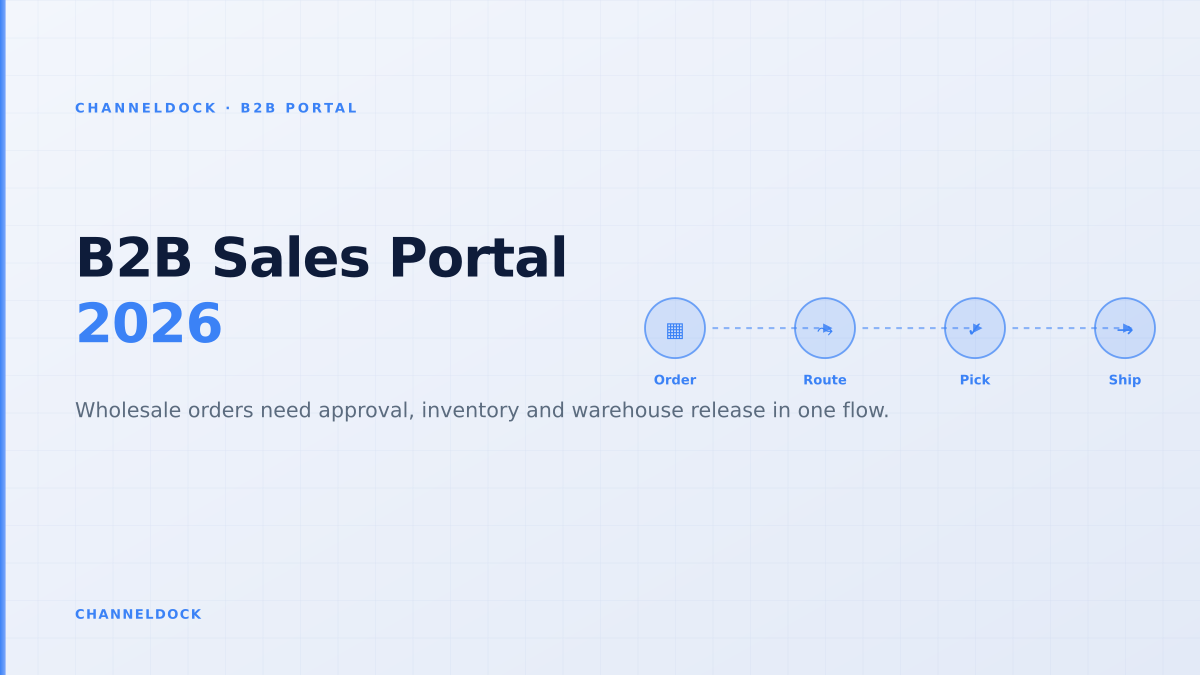
B2B Sales Portal: How Wholesale Orders Should Flow in 2026
Capterra's 2026 B2B ecommerce platform directory lists 299 products. That number tells a clear story: wholesalers, distributors and brands are no longer asking whether business buyers should order online. They are asking which portal can handle the messy operational reality behind every wholesale order.
The answer is rarely “the prettiest storefront.” A useful B2B sales portal must connect negotiated pricing, buyer permissions, inventory availability, approval gates, order documents and warehouse release. If those checks live in separate tools, the portal only shifts manual work from email to another queue.
Why B2B portals fail when they stop at checkout
Most ranking articles describe B2B portals as self-service websites where customers can browse a private catalog, see their own prices and place repeat orders. That definition is correct, but incomplete. The operational failure happens after the buyer clicks submit.
For a wholesaler, that submitted order may still need a credit check, a minimum-order check, a pack-size check, customer-specific pricing validation, stock allocation and shipping-route decision. If the warehouse sees the order before those rules are settled, the team starts picking something the business may later need to amend, split, delay or reject.
The most common B2B portal mistake is treating the portal as a nicer order form. A wholesale buyer does not only need a cart; they need their negotiated price, available stock, pack-size rules, credit limits, approval status and shipment promise to agree before the warehouse starts picking.
This is why the better question is not “do we have a B2B portal?” but “what percentage of portal orders arrive ready to fulfill?” A portal that needs daily cleanup by sales operations is not automation. It is a nicer front door on the same manual process.
The buyer experience depends on operational truth
Wholesale buyers are practical. They reorder known SKUs, compare their agreed price, check whether the product is available, and need confidence that the delivery date is realistic. Public competitor pages from OrderEase, OroCommerce, MRPeasy and Orderwerks all converge on the same feature set: customer-specific catalogs, real-time availability, order history, invoices, shipment status and ERP or warehouse integration.
The gap in most content is the handoff. A catalog page can say “in stock,” but an operations team knows that stock may already be reserved for Amazon, bol.com, a POS location, a retail promotion or another B2B account. For sellers running B2B beside ecommerce, the portal must read from the same inventory model that powers inventory control and order processing.
That is where ChannelDock's B2B Portal fits a different use case from a standalone wholesale storefront. The goal is not only to let dealers order online. The goal is to make those dealer orders usable inside the warehouse without re-keying, duplicate checks or spreadsheet allocation.
The control layer: price, stock, approval, release
A modern B2B sales portal should work like an order-control layer. Four checks matter before release:
- Price: the buyer sees the negotiated price, contract discount, currency and payment terms that match the account.
- Stock: the portal shows availability that can actually be promised after marketplace buffers, warehouse reservations and existing B2B allocations.
- Approval: orders above thresholds, outside terms or below margin are held for a traceable decision before fulfillment begins.
- Release: approved orders enter the operational queue with the right documents, pick instructions, carrier logic and customer communication.
Portal as a separate storefront
- Buyer places an order, then the office re-keys it into ERP or WMS.
- Prices, stock and approval rules are checked after submission.
- Warehouse teams discover commercial exceptions too late.
- Customer service becomes the status-update layer.
Portal as an order-control layerRecommended
- Buyer sees account-specific catalog, price and terms before ordering.
- Approval, stock and fulfillment checks run before warehouse release.
- Orders land in the same queue as marketplace and webshop demand.
- Tracking, documents and reorder history return to the buyer portal.
This distinction matters for brands that sell through a mix of channels. A company may accept D2C orders via Shopify, marketplace orders via Amazon or bol.com, POS orders from a store, and B2B orders from dealers. If the B2B portal is not connected to the wider integration layer, each channel competes for stock with different rules and different visibility.
What ranking pages miss: warehouse timing
Competitor content often lists the same feature checklist: custom pricing, quick order, reorder history, invoices and ERP sync. Those are necessary, but they do not explain when an order should become operational. That timing is the difference between a clean fulfillment flow and a warehouse full of reversals.
A B2B order should not be released to pick simply because the buyer pressed submit. It should be released when the portal, sales rules and inventory model agree that the order is commercially valid and physically fulfillable. That means the portal needs a status between “submitted” and “ready to pick.” In ChannelDock terms, this is where approval gates, document generation and fulfillment routing protect both sides: the buyer gets clarity, and the warehouse avoids preventable exceptions.
The best B2B portal is not the one with the most storefront features. It is the one that turns buyer intent into a warehouse-ready order with the fewest manual corrections.
A practical B2B sales portal operating model
For wholesalers and ecommerce sellers adding a B2B channel, the safest implementation sequence is operational, not cosmetic. Build the account rules first, then open the catalog.
- 1Start with the buyer account, not the product catalogMap each customer to the right price list, catalog access, shipping addresses, payment terms and approval role before you publish products.
- 2Show only stock that can actually be promisedReserve buffers for marketplaces, retail partners and existing B2B allocations so the portal does not sell inventory already needed elsewhere.
- 3Route exceptions before the warehouse sees themHold orders that break credit limits, pack-size rules, minimum order value or margin thresholds until sales or finance approves them.
- 4Release clean orders into one fulfillment queueOnce approved, B2B orders should flow into the same operational queue as webshop, marketplace, POS and manual orders.
- 5Return status, documents and reorder history to the buyerConfirmations, packing slips, invoices, tracking and repeat-order lists turn the portal into a service layer, not just a checkout page.
The sequence looks slower than launching a login page and uploading products, but it prevents the expensive failure mode: buyers adopt the portal, order volume rises, and the back office discovers that every “automated” order still needs manual validation.
Metrics that prove the portal is working
Portal success should be measured inside operations, not only in analytics. Useful metrics include:
- Ready-to-pick rate: the share of portal orders that enter the warehouse without manual correction.
- Approval cycle time: how long exceptions wait before sales or finance makes a decision.
- Price correction rate: how often invoices or order confirmations differ from the portal price.
- Stock promise accuracy: how often the promised quantity can be shipped without backorder or split shipment.
- Repeat-order speed: how quickly known buyers can rebuild a previous order from history or saved lists.
These metrics are more useful than generic “digital adoption” because they show whether the portal is reducing work for sales, customer service and the warehouse. A portal with high login volume but low ready-to-pick rate is still a cost center.
Where ChannelDock has a useful angle
ChannelDock's B2B Portal is strongest for businesses that do not run wholesale in isolation. Many ChannelDock customers already manage marketplace orders, webshop orders, inventory sync, warehouse picking, shipping labels and fulfillment partners. Adding B2B on top of that stack should not create a separate operational island.
The practical advantage is a unified order queue. B2B buyers can place orders through a controlled portal, while the seller keeps ownership of approval, documents and fulfillment routing. That is a better fit for wholesalers, distributors and brands that need B2B self-service but cannot afford stock drift between dealer orders and ecommerce demand.
- A B2B sales portal should reduce manual order entry, not move it from email into another disconnected inbox.
- The strongest portal metric is not traffic; it is the percentage of orders that arrive approved, priced, allocated and ready to pick.
- Real-time inventory matters most at the promise point: when the buyer decides whether to place a repeat order.
- ChannelDock is strongest when B2B orders must live beside marketplace, webshop, POS and fulfillment workflows in one operational queue.
FAQ
What is a B2B sales portal?
How is a B2B sales portal different from a normal webshop?
Should a B2B portal connect to inventory in real time?
Where should B2B portal orders go after approval?
Can ChannelDock support B2B wholesale orders alongside ecommerce orders?
Conclusion
The B2B sales portal category is crowded because the demand is real. Business buyers want self-service, accurate pricing, repeat ordering and clear status. But sellers need something deeper: a portal that respects inventory, approvals and warehouse timing.
For wholesalers and ecommerce brands, the winning portal is the one that turns a buyer's reorder into an approved, allocated, documented and ready-to-pick order. If your current process still depends on email checks, spreadsheet stock holds or manual ERP entry, the next step is not just a new storefront. It is an operational B2B portal connected to the systems that actually fulfill the promise.
Explore the ChannelDock B2B Portal or start for free to see how wholesale orders can flow into the same operational backbone as your other ecommerce channels.