Enterprise Order Orchestration for 3PL Operations
In 2026, the hardest enterprise logistics problem is no longer receiving orders from Shopify, Amazon, bol.com, SAP, NetSuite or a client's custom portal. The harder problem is deciding, in milliseconds and with auditability, what each order is allowed to become before it reaches the warehouse floor.
Search results for order orchestration, distributed order management and 3PL integration often explain the same pattern: connect ERP, WMS, TMS, marketplaces and carriers through APIs, EDI or middleware. That is useful, but incomplete for large logistics providers. A 3PL does not route one brand's order flow. It routes many client rulebooks, many warehouse capacities, many carrier contracts and many exceptions through one operating model.
Why enterprise order orchestration is moving upstream
A decade ago, many logistics teams could treat the WMS as the center of gravity. Orders arrived from a small number of channels, warehouse rules were relatively stable and client-specific complexity could be handled with custom fields or manual checks. That operating model breaks when a large 3PL serves dozens of ecommerce brands across marketplaces, retail stores, B2B portals, drop-ship flows and cross-border carrier networks.
The pressure now sits before the pick ticket. A marketplace order may need stock reservation within minutes. A B2B order may need account approval. A Shopify order may need routing to a nearby node. An ERP order may carry credit status or incoterms. A carrier label may depend on destination, weight, warehouse cut-off and client contract. If those decisions live in separate point-to-point integrations, the warehouse becomes the place where integration design failures show up.
The clean definition: orchestration sits before execution
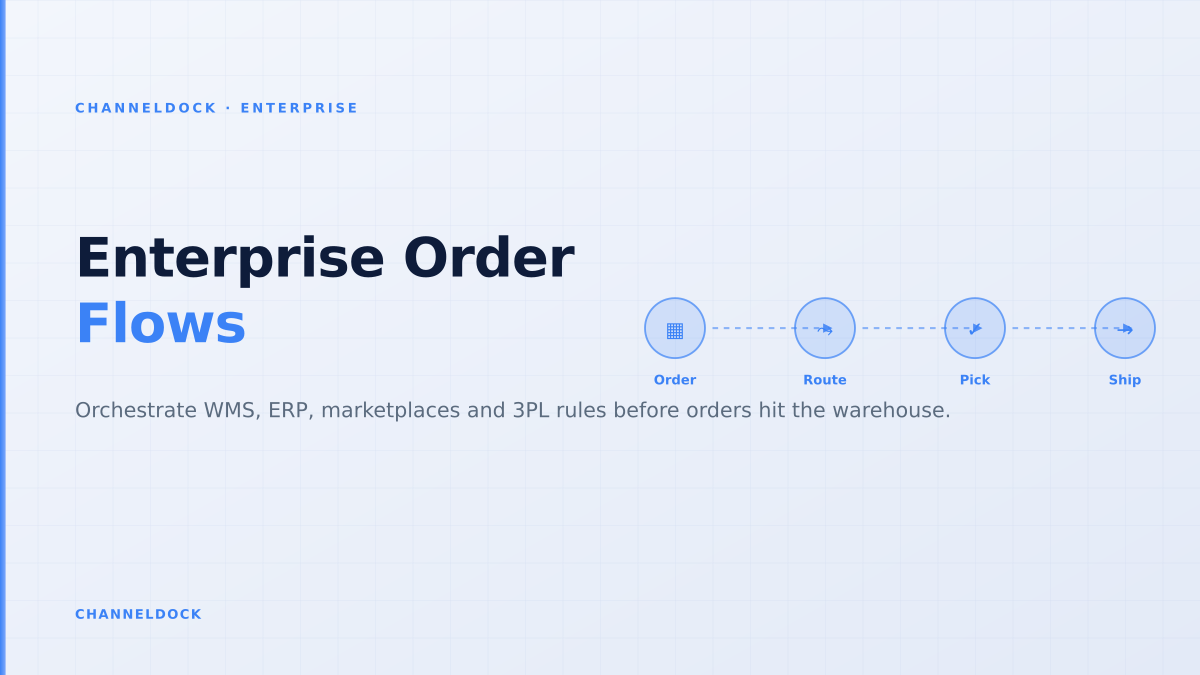
Enterprise order orchestration is not another name for order import. It is the decision layer between commercial demand and warehouse execution. It receives order events from many sources, normalizes them, applies business and operational rules, reserves inventory, chooses a fulfillment path, blocks risky work and returns status events to upstream systems.
For a large logistics provider, that layer matters because the 3PL is responsible for shared operational reality. One client may want every order shipped complete. Another may prioritize same-day partial release. A third may route high-value orders through a specific dock, packing slip or carrier account. ChannelDock's Enterprise Connect page exists for exactly this integration-heavy environment: WMS, ERP, marketplaces, API and EDI need one managed operating layer instead of a new custom build for every client.
Where the order orchestration layer should sit
The practical architecture is a hub between intake systems and execution systems. On the intake side are marketplaces, webshops, ERP, OMS, B2B portals, EDI feeds and client APIs. On the execution side are WMS, pick and pack, shipping labels, carrier handover, returns, billing and analytics. The orchestration layer owns the rules that decide whether an order is ready to cross from demand into work.
That does not mean replacing the WMS or ERP. It means being precise about ownership. ERP remains the source for financial controls, customer master data and accounting events. WMS remains the source for physical execution and stock movements. The orchestration layer owns order readiness, routing decisions, exception states and status fan-out.
Point-to-point order routing
- Every client integration carries its own routing logic.
- Warehouse teams discover bad rules after work is already released.
- Changing one carrier or channel can break several client flows.
- Exceptions are solved in tickets and spreadsheets.
Enterprise order orchestrationRecommended
- Routing logic is centralized, versioned and auditable.
- The WMS receives only work that passed operational gates.
- Client rules, carrier rules and warehouse capacity can change independently.
- Exceptions become structured events with owner, status and SLA.
The seven checks every enterprise 3PL order should pass
When a logistics provider grows, the question is not whether an order can technically be imported. Almost every platform can import an order. The higher-value question is whether the order is safe to release to the warehouse without creating downstream rework. A useful orchestration gate checks seven things before release.
- Client contract: does this client allow partial shipments, split lines, substitutions, branded documents or manual holds?
- Channel requirements: does Amazon, bol.com, Zalando, Shopify, WooCommerce or a B2B portal expect specific shipment, tracking or cancellation fields?
- Inventory promise: is sellable stock available, reserved and mapped to the correct SKU, EAN, ASIN or client item code?
- Warehouse capacity: can the selected node meet cut-off, labor, pick-path and packing requirements?
- Carrier fit: is the chosen service valid for destination, parcel profile, delivery promise and client contract?
- Exception risk: are address, payment, fraud, backorder, dangerous goods, customs or missing-data flags present?
- Status owner: which system must receive order accepted, blocked, released, shipped, partially shipped, returned or cancelled events?
- 1Normalize the order before routingConvert every source into the same operational vocabulary: order header, line items, SKU identity, promised delivery date, shipping method, client priority, stock reservation and exception flags.
- 2Score the fulfillment promiseCheck whether the requested delivery date, warehouse location, carrier service, cut-off time and inventory position can still produce a reliable promise.
- 3Apply client-specific rulesSome clients allow split shipments, substitutions, partial release or backorders. Others require exact shipment grouping, branded packing slips or approval before release.
- 4Send executable work to the WMSThe warehouse system should receive a clean instruction: pick these lines, from this node, under this service level, with these documents and exception rules.
- 5Loop status back to every upstream systemTracking, short-pick, cancellation, partial shipment, return and billing events must be sent back to the marketplace, ERP, OMS, B2B portal or client dashboard that owns the customer conversation.
Why this is different for a 3PL than for a retailer
Retail order orchestration usually optimizes one brand's fulfillment network. Enterprise 3PL order orchestration has to optimize across multiple brands that share people, space, docks, carrier pickups and support teams. That changes the design.
A retailer can tune rules around its own margin, customer promise and store network. A 3PL must also respect client-specific SLAs and commercial agreements while keeping the warehouse stable. A rule that is good for one client can hurt another if it consumes all late cut-off capacity or creates too many partial shipments. This is why orchestration should expose policy, not hide it in custom scripts.
A practical operating model for enterprise order orchestration
The strongest 3PL setup starts with a reusable order object. Every source system maps into the same internal structure: order source, client, buyer, ship-to, promised date, line items, identifiers, fulfillment constraints, stock status, documents, shipment preference and exception state. Once that object is stable, the rules around it can evolve without rewriting every integration.
Next, build rule ownership. Commercial teams own client-specific promises. Warehouse teams own operational feasibility. IT or integration teams own data contracts, API uptime and field mapping. Customer success owns what clients see in the portal. Without ownership, orchestration becomes another hidden middleware layer that nobody trusts.
Finally, connect order orchestration to the pages and features that already handle execution. ChannelDock's order features cover the operational order layer, while integrations connect marketplaces, webshops, carriers and back-office systems. The enterprise difference is governance: every new client connection should reuse the same event model, not restart from a blank project plan.
What to measure after go-live
Do not measure an order orchestration layer only by integration uptime. Uptime can be green while warehouse teams still fight bad release logic. The better scorecard combines technical health, operational quality and client visibility.
- Clean-release rate: percentage of imported orders that reach WMS without manual correction.
- Blocked-order reasons: top causes of holds, such as address issue, unmapped SKU, no stock, invalid carrier or missing approval.
- Intake-to-release time: how long it takes from order receipt to executable warehouse work.
- WMS rejection rate: how often the WMS refuses or errors on released work.
- Status-loop completeness: whether every upstream system receives accepted, released, shipped and exception events.
- Rule-change lead time: how quickly the team can adjust a client rule without touching core WMS code.
The best enterprise order orchestration layer is almost invisible to warehouse staff: bad work is blocked before it reaches them, good work arrives with clear instructions, and every client sees the same operational truth.
Implementation sequence: start with the riskiest decisions
A large logistics provider does not need to rebuild every integration at once. Start where wrong routing creates the most operational damage. For most enterprise 3PLs, that means marketplace orders with hard cut-offs, high-volume clients with custom packing rules, multi-node stock allocation and carrier services that fail if fields are incomplete.
Once those flows are stable, expand into less urgent but still valuable areas: B2B approvals, returns events, billing triggers, order-change events, backorder release and client dashboard visibility. The goal is not to add ceremony. The goal is to make every new enterprise client easier to onboard than the previous one.
- Treat order orchestration as a control layer, not a synonym for WMS, OMS or ERP.
- Put client-specific rules before warehouse release, not inside pack-station workarounds.
- Model the full order lifecycle: intake, validation, allocation, release, exception, shipment, return and billing signal.
- Measure orchestration quality by avoided exceptions, clean WMS releases and status-loop completeness.
- Use reusable integration patterns so each new enterprise client does not become a separate rebuild.
FAQ: enterprise order orchestration
What is enterprise order orchestration for a 3PL?
Is order orchestration the same as a WMS?
Why do large 3PLs need orchestration if they already use an ERP or WMS?
Which systems should connect to an order orchestration layer?
What should a 3PL measure after implementing order orchestration?
Conclusion
Enterprise order orchestration is the layer that keeps large logistics providers from turning every client, marketplace and ERP connection into another fragile custom project. It gives the WMS clean work, gives clients reliable status and gives operations a place to change rules without breaking the warehouse.
For 3PLs moving from integration projects to a repeatable enterprise platform, the next step is to define the order event model, the release gates and the ownership of each rule. That is where Enterprise Connect creates leverage: one integration operating layer across WMS, ERP, marketplaces, carriers, API, EDI and client portals.