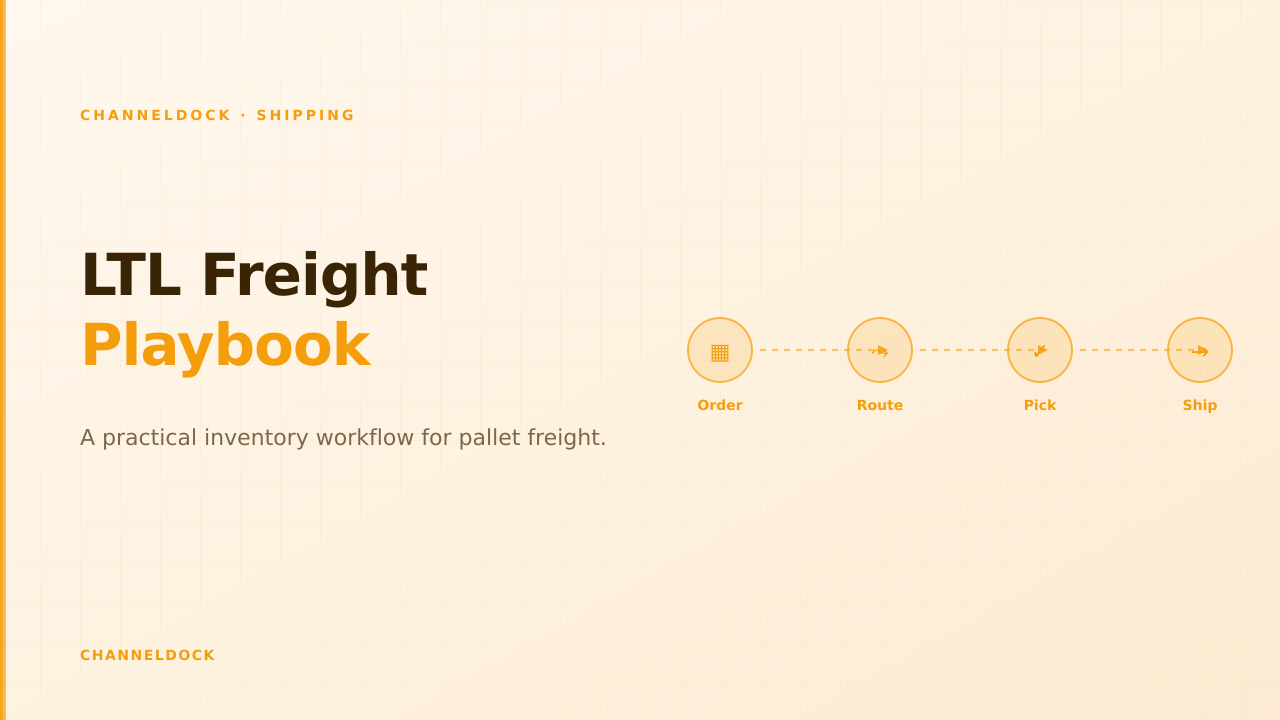
LTL Freight Shipping for Ecommerce: A Practical Seller Playbook
On June 10, 2026, Amazon Supply Chain Services opened its less-than-truckload freight service beyond inbound Amazon shipments to third-party warehouses, distribution centers, retail partners and other destinations. The headline numbers are practical for ecommerce operators: 1–6 pallets, 150–15,000 pounds, next-day live pickup for orders placed by 5 p.m., plus GPS tracking, automated appointment scheduling and electronic proof of delivery.
That matters because many multi-channel sellers are now too large for ad hoc parcel replenishment but not large enough to fill a truck. The opportunity is not simply cheaper freight. It is a cleaner operational handoff between purchasing, warehouse receiving, marketplace inventory and order routing.
Why LTL is suddenly an ecommerce operations topic
Traditional ecommerce advice treats freight as a procurement problem: compare rates, book the lane, wait for delivery. That misses the failure mode sellers feel every week. When a pallet sits between supplier, warehouse and 3PL, the operational system must know whether those units are sellable, reserved, damaged, delayed or ready for pick and pack.
Amazon's expanded offer makes LTL more visible because it packages freight with the kind of milestone data sellers already expect from parcel carriers. But the same principle applies whether the carrier is Amazon Freight, DHL Freight, FedEx Freight, DSV, PostNL Extra@Home or a local pallet network: freight only helps ecommerce when the inventory state changes with the shipment.
The cheapest pallet quote is not automatically the best ecommerce option. If the WMS, marketplace stock buffer, carrier appointment and proof-of-delivery data do not update together, sellers simply move the bottleneck from parcel shipping to inventory reconciliation.
The seller decision rule: use LTL for planned replenishment, not chaos
LTL freight is best when the lane is predictable: supplier to your warehouse, warehouse to a fulfillment partner, warehouse to retail distribution center, or overflow stock into a secondary location. It is less useful as a panic move after a marketplace stockout has already started.
The operational test is simple: if the receiving team can plan dock capacity, the marketplace team can set stock buffers, and the WMS can reconcile SKUs by barcode when the pallet lands, LTL can reduce cost and improve control. If those pieces are missing, pallet freight may hide errors until the whole pallet arrives late or incomplete.
Parcel-first replenishment
- Simple labels but high per-unit cost once cartons stack up
- Tracking lives outside the warehouse plan
- Easy to forget marketplace stock buffers
LTL-driven replenishmentRecommended
- One pallet move can feed multiple channels
- Appointment and POD data support receiving discipline
- Needs inventory reservations and SKU-level reconciliation
A four-step LTL workflow for multi-channel sellers
Before sellers add another freight provider or Amazon Supply Chain Services lane, they should write the workflow in the same language the warehouse uses: SKU, barcode, quantity, location, carrier milestone and exception owner. This is where integrations between ERP, WMS, marketplaces and carrier data become more important than the freight quote itself.
- 1Separate replenishment freight from customer ordersUse LTL for pallet movements into your warehouse, 3PL, Amazon facility or retail partner; keep single-customer orders on parcel carrier rules unless the item is naturally bulky.
- 2Reserve stock before the pallet leavesIn ChannelDock, reduce sellable stock or create a warehouse transfer so bol.com, Amazon, Shopify and other channels do not oversell while the pallet is in transit.
- 3Attach tracking to the warehouse workflowStore appointment windows, GPS milestones, EDI events and electronic proof of delivery where the pick, pack and receiving teams can see them.
- 4Reconcile receiving by SKU and barcodeWhen the pallet arrives, scan cartons or units into the WMS/Warenwirtschaft before releasing stock back to marketplaces.
What current ranking content misses
Most LTL explainers define accessorials, NMFC classes and pallet dimensions. Useful, but incomplete for ecommerce. A seller operating bol.com, Amazon, Shopify, Kaufland and TikTok Shop needs to know when to freeze inventory, how to split replenishment across warehouses, and what happens when a pallet is received with shortages.
The missing layer is exception design. A good ecommerce freight process answers five questions before the first pickup: which channel gets stock first, which SKUs are buffered, who owns delivery appointment failures, how receiving discrepancies are logged, and how customer-facing availability changes if the pallet misses its planned dock date.
The best LTL strategy is not the lowest rate per pallet; it is the fastest path from freight milestone to accurate sellable stock.
Conclusion
Amazon's LTL expansion is a signal that pallet freight is moving closer to mainstream ecommerce operations. Sellers should not wait until volume forces the issue. Build the inventory workflow now: reserve stock before pickup, connect carrier events to receiving, scan by SKU at arrival, and release marketplace availability only after the WMS confirms what actually landed.
- Treat LTL freight as an inventory workflow, not just a cheaper shipping label.
- Create transfer stock, buffers and receiving scans before opening another freight lane.
- Use connected integrations so ERP, WMS, carrier milestones and marketplaces share one operational truth.
- Start with repeatable lanes: supplier to warehouse, warehouse to 3PL, or warehouse to retail partner.