B2B Order Change Requests: Portal Rules Before Picking
In 2026, the strongest B2B portal conversations are no longer about whether wholesale buyers should place orders online. That part is settled. The harder operational question is what happens after a buyer submits a 60-line order and then needs to change a quantity, PO reference, ship-to address, delivery date, or product substitution before the warehouse starts picking.
That gap showed up clearly in research for B2B order portals. BigCommerce frames B2B order management as complex because it combines large orders, custom pricing, multiple decision-makers and fulfillment pressure. Shopify Community threads show buyers asking for location admins to review, edit and approve pending B2B draft orders from the storefront. ShipBob's B2B guidance makes the warehouse consequence visible: adjustments to B2B orders can become paid requests once inventory work is affected. Competitor pages discuss portals, approvals and self-service, but most stop before the exact change-control rules that protect the warehouse.
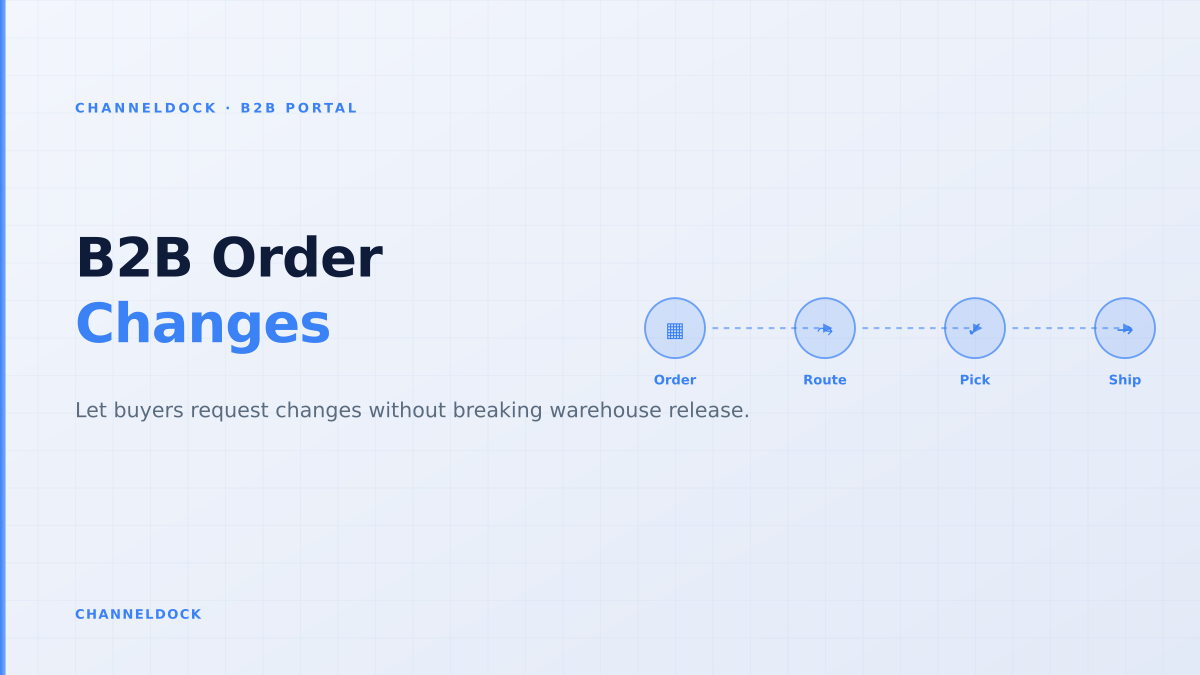
The practical answer is not “let buyers edit everything”. It is a controlled B2B order change request workflow: buyers can ask for changes, the portal checks what is still safe, the commercial team approves exceptions, and only then does the order move into ChannelDock's B2B Portal, picking, packing and shipping. The goal is simple: keep wholesale buyers self-served without turning the warehouse into a helpdesk.
Why change requests deserve their own workflow
Wholesale orders are rarely as clean as a consumer checkout. A retailer may submit before their branch manager approves the basket. A dealer may realise the PO number belongs to the wrong cost centre. A franchise location may request a delivery-date change after checking shelf space. A sales rep may promise a substitution when the original SKU is short. None of these are unusual. They are normal B2B behaviour.
The problem is that most portals treat the order as finished the moment the buyer clicks submit. The buyer then moves to email, the sales rep moves to the admin panel, the warehouse prints a pick list, and the finance team finds out later that the invoice does not match the buyer's expectation. That is why order-change logic belongs inside the portal flow, not beside it.
The expensive mistake is treating a change request like a customer-service note. If the note lives outside the order, the picker still sees the old quantity, the buyer expects the new promise, and finance has no clean record of who approved the difference.
The four fields every request must capture
A change request is useful only when it is specific enough for automation. At minimum, capture the requester, the exact field being changed, the old and new value, and the reason. A line-level quantity change is different from a header-level delivery change. A PO-number correction is different from a margin-impacting discount request.
Good portals also capture company location and buyer role. The Shopify Community request for buyer-side editing rights is a useful signal: B2B companies often need internal approval before an order reaches the merchant. If the portal does not know whether the requester is an ordering user, location admin, sales rep or finance approver, every change becomes a manual judgment call.
- Line changes: SKU, quantity, unit, substitution, backorder preference.
- Header changes: PO number, cost centre, buyer contact, delivery date, ship-to address.
- Commercial changes: discount, price tier, credit term, freight charge, tax or VAT field.
- Warehouse changes: shipment type, pallet/freight instruction, packing note, carrier rule.
A safe B2B order change workflow
The best workflow is strict at the warehouse edge and flexible before that edge. Buyers should not need to call sales for a PO typo. Sales should not need to rebuild an order because the buyer increased a case quantity. But the warehouse must never pick from an order that is still under negotiation.
- 1Capture the buyer's requested change as structured dataDo not accept a free-text email as the source of truth. Capture line item, old value, requested value, reason, buyer, company location and PO reference.
- 2Check the order status before anything changesA request on a draft order is different from a request on a released pick list. Use statuses like draft, pending approval, released, picked, packed and shipped.
- 3Re-run pricing, credit and stock rulesA quantity increase can trigger a volume discount, credit-limit hold, MOQ rule, backorder split or warehouse reassignment.
- 4Approve or reject with a visible explanationBuyer, sales, finance and warehouse need the same decision record. Rejecting a change should be as traceable as approving one.
- 5Release a clean order version to the warehousePickers should see one current order, not an email thread. The audit trail can keep previous versions, but the floor needs a single instruction.
Where competitors leave a gap
Most ranking content explains that B2B portals should support approvals, order history, customer-specific pricing, inventory visibility and self-service. That is true, but incomplete. The missing layer is order version control. An approval workflow answers “may this buyer place the order?” A change-request workflow answers “may this submitted order become a different order before we release it?”
That distinction matters for distributors, brands and manufacturers because the operational cost sits downstream. A portal can look modern while still creating warehouse rework if approved changes are not reflected in pick lists, packing slips, stock reservations and order documents.
Free-form edits after checkout
- Buyer sends email or calls sales
- Order desk changes lines manually
- Warehouse may already have printed the pick list
- Finance sees the dispute after shipment
Controlled change requestsRecommended
- Buyer requests a specific field change in the portal
- System checks order status, stock and permissions
- Exception is approved before warehouse release
- Version history stays visible for claims and invoicing
The warehouse-release rule
Every B2B portal needs a hard release point. Before release, changes can be evaluated and rolled into the order version. After release, changes require a hold, cancellation, return-to-stock action or follow-up order. Without that rule, a buyer's “quick change” becomes a silent instruction conflict on the warehouse floor.
In ChannelDock terms, the B2B portal should not live apart from order processing, inventory checks and pick-pack execution. The same logic that creates the order should decide when it is safe to move into the pick and pack workflow. If a change affects stock, the stock promise must be rechecked. If it affects fulfillment, the pick list should be regenerated only after approval.
The cleanest B2B order is not the one with zero changes. It is the one where every change is approved before the warehouse acts on it.
A practical timeline from request to release
For a high-volume wholesale team, speed matters. The workflow should move in minutes, not days. The point is not to slow down the buyer. The point is to stop uncontrolled edits from bypassing the operational rules that protect margin, stock accuracy and delivery promises.
- T+0 minBuyer submits the orderPortal stores company, location, buyer role, PO number, lines, promised dates and current stock promise.
- T+12 minBuyer spots a changeThey request two extra cases, a corrected PO reference or a different branch address before approval.
- T+14 minRules run againCredit exposure, MOQ, price tier, stock reservation and delivery cut-off are rechecked against the requested version.
- T+20 minCommercial approval happensRoutine changes can pass automatically; margin, credit or substitution exceptions route to the right approver.
- T+25 minWarehouse receives version twoPick lists, packing slips and shipment instructions are regenerated from the approved order, not from a side note.
What to measure after launch
Order-change data is a product-management goldmine. If many buyers change quantities after submission, your minimum order quantity or case-pack display may be unclear. If PO-number corrections are common, the checkout field may need validation. If address changes happen after approval, company-location permissions may be too loose. If substitutions are frequent, your B2B catalog may be promising stock or variants the warehouse cannot support.
Track requests by reason, status at request time, approval outcome, minutes to decision and whether the warehouse had already released work. Then route the recurring causes back into portal design: clearer availability, stronger buyer permissions, better reorder templates, or stricter cut-off communication.
- Treat order changes as controlled requests, not informal messages.
- Block unsafe edits after picking starts, but keep a visible path for cancellation, replacement or a new order.
- Connect B2B portal permissions to inventory, credit, pricing and warehouse release rules.
- Measure change-request volume by reason so sales can fix recurring catalog, MOQ or pricing confusion upstream.
FAQ
What is a B2B order change request?
Should wholesale buyers be allowed to edit orders themselves?
Which order changes need approval?
How does this connect to a B2B portal?
What happens if the warehouse has already started picking?
Conclusion
B2B order change requests are where buyer convenience meets warehouse reality. Let buyers self-serve the request, but keep the release logic strict: structured fields, role permissions, rechecked pricing and stock, visible approval, and one clean order version for the warehouse.
That is the difference between a portal that merely captures wholesale orders and a portal that protects the full order flow. For B2B sellers, the winning setup is not “edit everything” or “lock everything”. It is controlled flexibility before picking, and operational discipline after release.