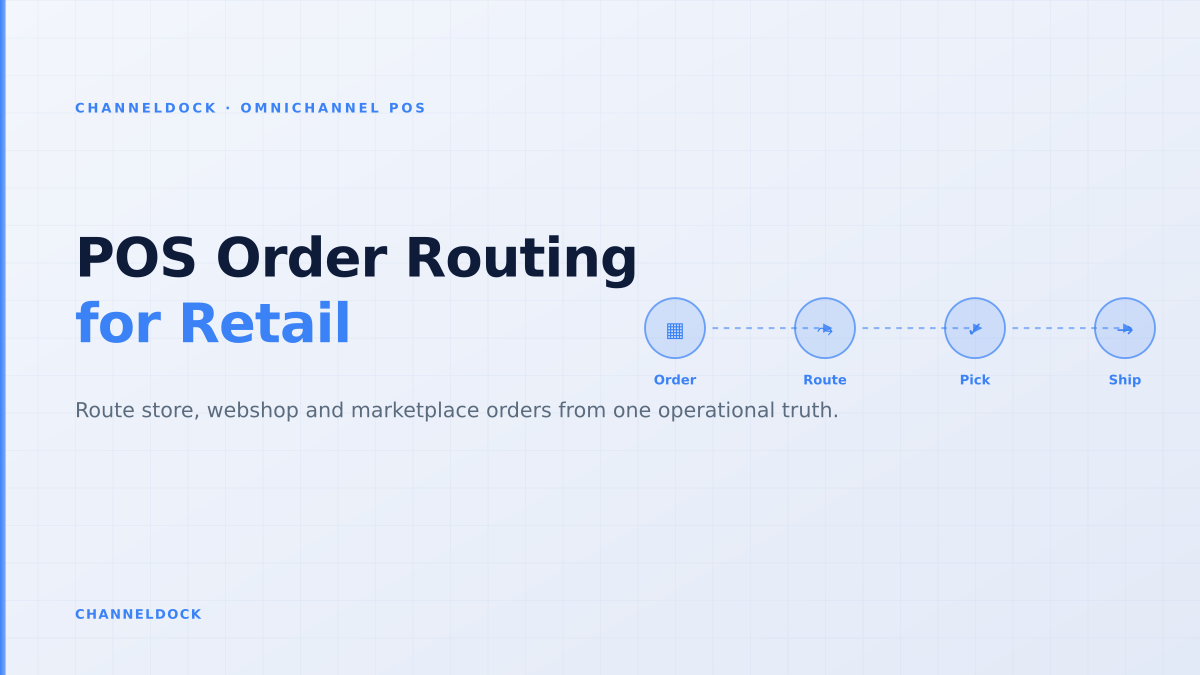
POS System Ecommerce Order Routing: Stop Store Fulfillment Breaks
In 2026, retail order routing is no longer only a warehouse problem. Shopify now describes omnichannel POS as the shared layer for customer, order, inventory and fulfillment data, while Lightspeed calls ghost inventory one of the biggest risks in store-based fulfillment. Kibo’s ship-from-store research is even sharper: store fulfillment only works when store stock accuracy stays above 98%, otherwise the order fails at the pick step after the customer has already received a promise.
That is the gap most ranking POS articles still miss. They explain payments, hardware and online-store sync, but they rarely show how an ecommerce order should decide between the shop floor, backroom, central warehouse, marketplace buffer and carrier cutoff. For retailers selling through Shopify, WooCommerce, bol.com, Amazon or a physical counter, the real question is: can the POS system feed the same operational truth used by the order management workflow, inventory controls and marketplace integrations?
Why POS routing breaks after the first store
A single-store retailer can often survive with a simple rule: sell from the location where the order was created. The moment a second store, warehouse, pop-up or marketplace enters the picture, that rule becomes dangerous. The POS may know that an item was sold at the counter, but the webshop needs to know whether the remaining unit is available for pickup, ship-from-store, endless aisle, marketplace sale or reservation for an existing order.
The failure usually starts with a small delay. A store associate sells the final medium jacket at 14:02. The ecommerce platform still shows one available at 14:05. A marketplace order lands at 14:06. By the time the back office reconciles the event, the retailer has two promises for one unit. That is not a POS problem in isolation; it is a routing architecture problem.
Do not judge POS ecommerce integration by whether stock eventually syncs. Judge it by whether the routing engine can make a safe decision while stock is changing at the register, in the warehouse and on marketplaces at the same time.
The five routing signals every POS order needs
A good POS system ecommerce order routing setup treats the POS as one input into a shared order layer, not as a separate retail island. Each new order should be scored against five signals before it is released to picking:
- 1Available-to-sell by locationUse physical stock minus reservations, buffers, damaged goods, transfer stock and items already promised to other channels.
- 2Fulfillment capabilityCheck whether the location can actually pick, pack, print a label and hand off to the selected carrier before cutoff.
- 3Customer promiseCompare pickup window, delivery address, marketplace SLA, loyalty tier and any promised ship date.
- 4Inventory strategyPrefer aging stock, protect fast-moving floor units and keep marketplace buffers for channels with strict cancellation penalties.
- 5Exception pathDefine what happens when the assigned store cannot find the item: reroute, split, substitute, hold or cancel with a customer-service reason.
What competitors explain well — and what they leave open
Shopify and Lightspeed both do a strong job explaining omnichannel POS basics: unified profiles, BOPIS, BORIS, returns and inventory visibility. Square’s POS content focuses on small-business simplicity and inventory management. Kibo and enterprise OMS vendors go deeper into ship-from-store economics, including routing by proximity and store capacity. The missing middle is the multichannel retailer who has a POS, an ecommerce platform, marketplaces and a warehouse system that all matter at once.
That retailer does not only need a checkout. They need a decision layer that understands SKU mapping, warehouse sections, marketplace buffers, barcode picking and the exact point where an online promise becomes unsafe. This is where ChannelDock’s POS proposition fits: POS terminals feed the same operational inbox as webshops, B2B, marketplaces and manual orders, instead of creating a second source of truth.
POS as a checkout tool
- Great for taking payment in store
- Often syncs stock after the sale
- Store staff work from POS screens while warehouse teams work elsewhere
- Routing exceptions are solved manually
POS as an operational signalRecommended
- Counter sales update the same inventory ledger
- Online orders can route to store, warehouse or split flow
- Barcode and pick-pack workflows see POS-originated demand
- Returns and exchanges feed stock status immediately
A practical routing model for omnichannel retailers
Use a three-layer model. First, the inventory layer decides what can be promised. Second, the order layer decides where that promise should be fulfilled. Third, the execution layer tells a person or scanner exactly what to do. If any layer is hidden inside the POS only, the business loses control as soon as a marketplace or warehouse order competes with a store order.
For example, a shoe retailer may receive a Shopify order for two SKUs. One pair is available in Store A, one pair is in the central warehouse, and both SKUs are also listed on bol.com. A weak setup either routes the whole order to the default warehouse or lets Store A accept it without checking the second line. A stronger setup can split the order, reserve the warehouse unit, reduce marketplace availability, and keep the customer promise intact.
How to measure whether the setup is working
The best measurement is not “does the POS integrate with ecommerce?” That is too vague. Measure the failure points where routing actually costs money:
- Pick-fail rate by location: orders assigned to a store or warehouse that cannot find the item.
- Last-unit oversell rate: SKUs sold online after the POS or another channel already consumed the final unit.
- Manual reroute count: orders moved by customer support or warehouse leads after initial assignment.
- Marketplace cancellation exposure: orders from Amazon, bol.com, Zalando, OTTO, Kaufland, Temu or TikTok Shop that risk penalty because stock was promised too optimistically.
- Return-to-stock delay: time between an in-store return and the item becoming correctly available for resale.
If the POS report says stock is correct but the warehouse keeps rerouting orders, trust the operational metric. Pick-fail rate is a better truth signal than a clean end-of-day stock report.
ChannelDock angle: POS orders belong in the same inbox
ChannelDock’s advantage for this topic is not trying to replace every POS in the market. The stronger positioning is operational: POS orders, marketplace orders, webshop orders, B2B orders and manual orders should land in a shared process with stock sync, routing rules and warehouse execution around them. That lets retailers keep physical checkout simple while still running sophisticated order logic behind it.
For teams already using scanners, WMS workflows or marketplace integrations, the routing question is usually immediate: can this POS sale reduce the right SKU everywhere, can this online order be picked in store without stealing stock from another promise, and can the return update the same ledger? If the answer is yes, omnichannel POS becomes a growth layer. If the answer is no, every new store or channel multiplies manual reconciliation.
- Choose POS software by the quality of its operational signals, not only checkout speed or payment hardware.
- Build order routing around available-to-sell inventory, not raw stock on hand.
- Keep store fulfillment, BOPIS, BORIS and marketplace promises in the same order queue wherever possible.
- Track pick-fails and manual reroutes weekly; they reveal integration gaps before customers do.
FAQ
What is POS system ecommerce order routing?
Is this different from POS ecommerce integration?
Why do omnichannel POS projects fail?
Can store inventory be used for marketplace orders?
Where does ChannelDock fit?
Conclusion
Omnichannel POS is no longer a feature checklist. For growing retailers, it is an order-routing discipline. The winning setup is the one that keeps store sales, ecommerce orders, marketplace promises, warehouse stock and returns in one operational truth. Build that first, and the POS becomes more than a checkout: it becomes a reliable signal in the whole fulfillment network.