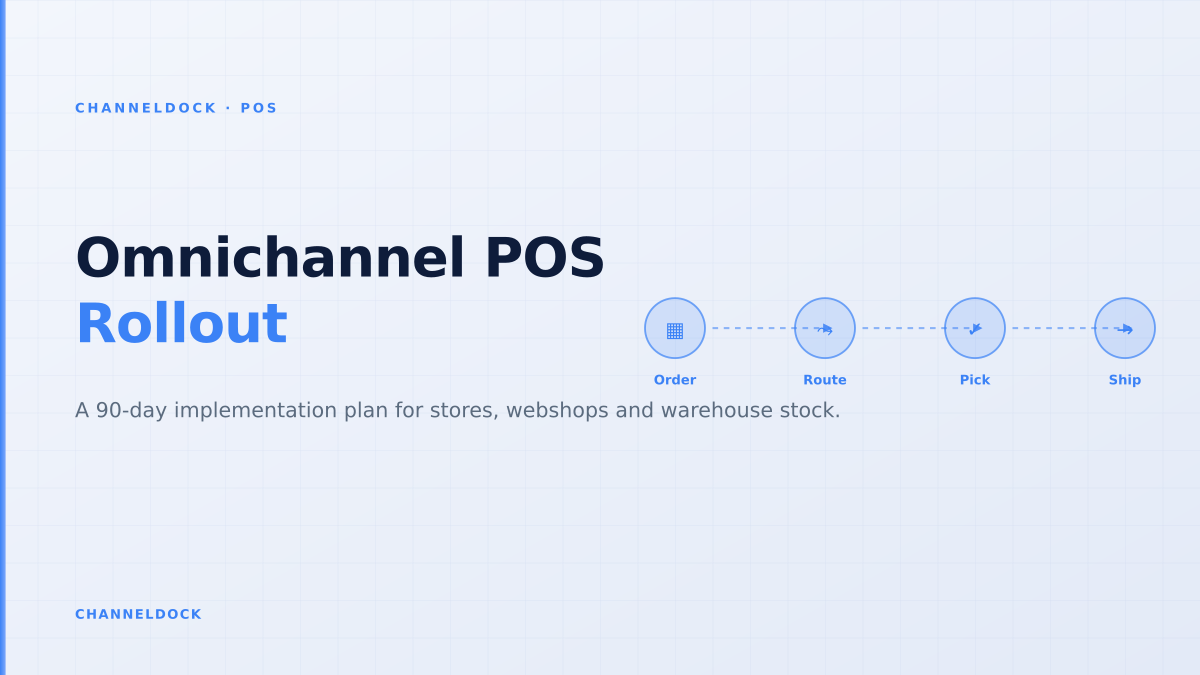
Omnichannel POS Implementation: 90-Day Retail Rollout Plan
The weekly competitor analysis for ChannelDock’s Omnichannel POS solution shows a clear opening: omnichannel POS has commercial intent, low keyword difficulty and an AI Overview result, while the broader point of sale software query is crowded by generic buying guides. The gap is implementation. Most ranking pages explain what an omnichannel POS is; far fewer explain how a retailer should roll it out without breaking stock accuracy.
That difference matters. Shopify’s 2026 omnichannel POS guide defines the category around shared customer, order, inventory and fulfillment data. Lightspeed frames the POS as the central nervous system for retail fulfillment. Square explains APIs and middleware for integrated POS workflows. Those are useful starting points, but store operators still ask practical questions in Shopify Community, Square Community and Reddit: why does inventory not sync, what owns the stock count, how are online orders pushed into the POS, and how do returns update sellable stock?
This guide gives a 90-day rollout plan for retailers and brands that sell through a physical store, webshop, marketplaces and a warehouse. ChannelDock’s Omnichannel POS solution sits in that operational middle: POS terminals keep doing checkout, while ChannelDock connects store sales with webshop orders, marketplace reservations, B2B orders and warehouse work through one control layer.
The gap in current omnichannel POS advice
Competitor content is strong on feature lists. Shopify highlights real-time stock syncing, unified profiles, BOPIS, BORIS and reporting. Lightspeed covers retail fulfillment, ghost inventory and store-based fulfillment. NetSuite explains POS integration with ecommerce, inventory, accounting, ERP and CRM. The missing piece is the sequence: which flow should be connected first, what should be delayed, and what must be tested before every store receives the new workflow?
A retailer can pass a demo with a perfect in-store sale and still fail in production. Real life adds simultaneous Shopify orders, offline POS mode, pop-up stock, marketplace buffers, damaged returns, manual adjustments, bundle SKUs and staff who need a simple screen during a queue. An implementation plan must therefore treat inventory as a ledger of events, not a number that gets copied between systems.
The dangerous implementation shortcut is connecting checkout first and deciding inventory ownership later. That creates two operational truths: the POS thinks a unit is available, while the webshop, marketplace or warehouse may already have promised it.
Start with an inventory ownership map
Before connecting APIs, write down each stock movement and assign ownership. A POS sale should reduce sellable stock. A webshop order should reserve stock before picking. A marketplace order may need a buffer because marketplace cancellations and payment states differ. A return should not increase available stock until staff confirm the item is sellable. A transfer should reduce one location and increase another only when the receiving team confirms it.
This is where a POS-only view becomes too narrow. The checkout terminal sees the sale, but it often does not understand Amazon reservations, B2B backorders, 3PL picking status or warehouse replenishment. ChannelDock’s integration layer can connect those events so POS, webshop and marketplaces read from one operational reality instead of overwriting each other.
Feature-led POS rollout
- Connect every available integration at once
- Treat “real-time sync” as a checkbox
- Discover SKU, return and transfer problems after go-live
- Store staff fix exceptions manually
Operations-led rolloutRecommended
- Define inventory ownership before connecting channels
- Test one stock movement at a time
- Use exception queues for mismatches
- Scale after reconciliation is boring
The 90-day rollout plan
A safe implementation is deliberately smaller than the final ambition. Do not begin with every store, every marketplace and every SKU. Start with the location and product group where errors are visible but survivable: fast-moving items, clear barcodes, simple variants and a store team willing to report exceptions.
- 1Weeks 1–2: name the source of truthDecide whether POS, ecommerce, ERP, WMS or ChannelDock owns each stock movement: sale, return, adjustment, reservation, transfer and damaged item.
- 2Weeks 3–4: clean SKU and barcode dataMatch every store barcode to the webshop SKU and marketplace listing before the first live sync. Variants, bundles and gift sets need explicit mapping.
- 3Weeks 5–6: pilot one store and one channelStart with a narrow flow such as store sales to online availability, then add online orders into the store or warehouse queue.
- 4Weeks 7–8: add exception rulesDefine what happens when a sale arrives during offline POS mode, a return is unsellable, or a marketplace order reserves the last unit.
- 5Weeks 9–12: scale channels and reportingAdd marketplaces, B2B, transfers and replenishment once the first pilot shows accurate availability and clean reconciliation.
What to test before go-live
The pilot should test operational events, not just API connectivity. A connector that updates stock after a sale is only one part of the flow. The test script should include an in-store sale during a busy online period, a webshop order for the last unit, a marketplace order that arrives seconds later, an online order returned to the store, an exchange, a damaged return, a stock transfer from warehouse to store, and an offline POS sale that syncs later.
For each event, record the expected result in the POS, ecommerce platform, ChannelDock, warehouse queue and marketplace availability. If two systems disagree, do not ask store staff to remember a workaround. Create an exception rule: hold the order, block the SKU, require a recount, or route the mismatch to operations before the item is promised again.
- Day 0Freeze scopeOne store, one webshop, one warehouse location and the 50 SKUs most likely to oversell.
- Day 14Map truth tableDocument which system writes each inventory event and which systems only read it.
- Day 30Run shadow syncCompare POS, webshop and ChannelDock availability without exposing the new numbers to shoppers yet.
- Day 60Go live on pilotAllow automated stock updates, order intake and return adjustments for the pilot channel.
- Day 90Scale cautiouslyAdd marketplaces, pop-up stock, B2B orders and store-to-warehouse transfers only after exception rates are stable.
What forums and review sites reveal
The clearest implementation signals come from support forums, not vendor feature pages. In one Square Community thread about website quantities not syncing with Square Item Library, the conversation grew to 86 messages and almost 40,000 views, with sellers reporting oversell risk when online inventory failed to reflect POS or dashboard changes. Shopify Community threads ask how to link an existing POS with Shopify, how to sync stock levels, pricing and product data in real time, and how to push online orders into the POS without manual work.
G2 reviews for Shopify POS show the upside and the limit at the same time. Reviewers praise real-time inventory sync and unified online-to-store operations; cons mention cost, customization limits, connectivity issues and brittle handling for more complex inventory. The lesson is not that one platform is “bad.” The lesson is that POS implementation becomes harder as soon as the retailer adds marketplaces, warehouses, B2B flows or non-standard SKUs.
Community threads show the real pain: sellers are not asking for prettier checkout screens. They ask how to link POS inventory to Shopify, how to push online orders into the POS, and why online quantities still show available after in-store sales.
How ChannelDock fits the rollout
ChannelDock should not be positioned as another checkout tool. The POS remains the store’s payment and receipt workflow. ChannelDock becomes the operational control layer around it: online orders, manual orders, B2B orders, marketplace sales, store sales, shipping labels, warehouse picking and stock sync can be managed from one place. Retailers can connect inventory controls and order workflows without asking the POS to become a full WMS, OMS and marketplace hub.
That separation is useful during implementation. The store team keeps a familiar checkout flow, while operations defines buffers, reservations, replenishment and exception queues centrally. If a POS sale, Shopify order and marketplace order compete for the final unit, the business should not rely on whichever system syncs last. It needs a deliberate rule for available-to-sell stock.
Conclusion
An omnichannel POS implementation succeeds when reconciliation becomes boring. Every sale, return, reservation and transfer should move through a known flow, with clear ownership and visible exceptions. Retailers that start with feature checklists often discover the hard problems after go-live. Retailers that start with inventory ownership, pilot scope and exception rules build a POS rollout that can survive real stores, webshops, marketplaces and warehouse pressure.
- Pick the system of record before buying POS hardware or adding marketplace connectors.
- Test stock movements, not just sales: returns, cancellations, transfers, damage and offline sales all change sellable stock.
- Keep store staff out of reconciliation spreadsheets by routing mismatches into one operational exception queue.
- Use ChannelDock as the control layer between POS, webshop, marketplaces, B2B and warehouse work when one POS cannot own the whole operation.