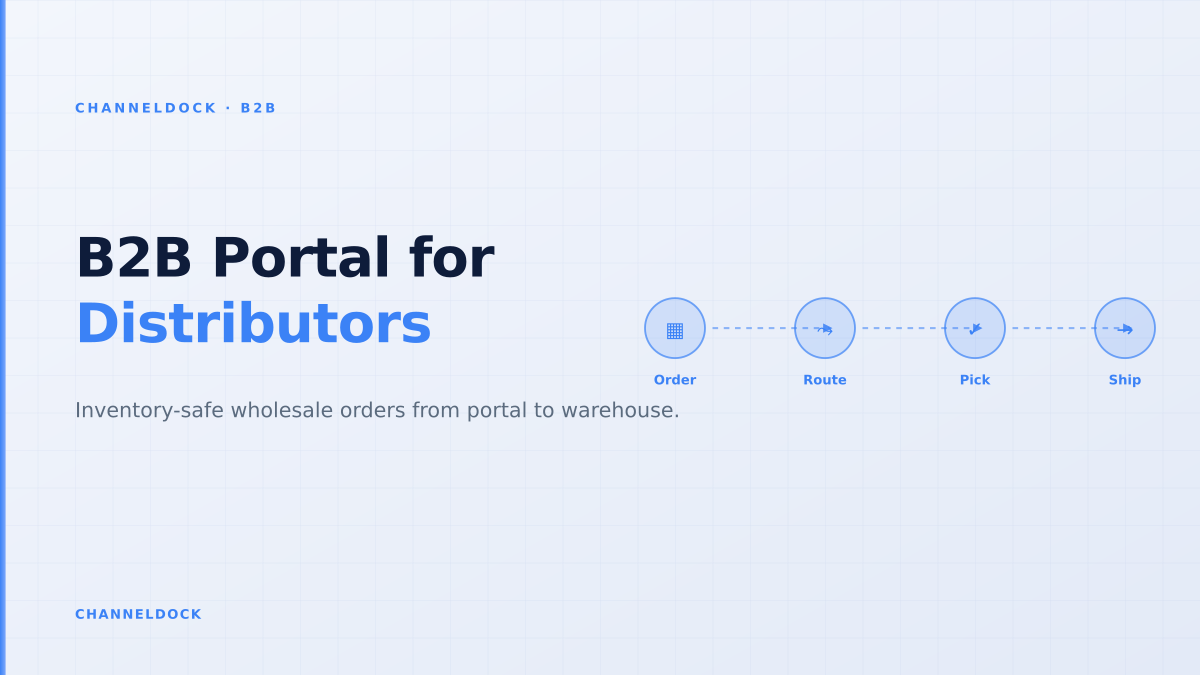
B2B Portal for Distributors: Inventory-Safe Wholesale Orders
The weekly competitor analysis for ChannelDock shows why this topic deserves another, sharper angle: B2B portal carries roughly 1,000 monthly searches, B2B ecommerce portal adds another 350, and ChannelDock already has visibility for B2B online ordering portal. The search results are busy, but most ranking pages still treat distribution as a website problem. They talk about digital catalogs, self-service and buyer experience, then only briefly mention what happens after the buyer clicks "place order".
That gap matters for distributors. A distributor does not simply sell products online. It promises stock across warehouses, protects customer-specific prices, handles case packs and minimum order quantities, routes orders around credit limits, serves reps and dealers, and still has to ship on time. A B2B portal for distributors is only valuable if it turns those operational rules into a clean wholesale order before the warehouse sees it.
Why distributor ecommerce breaks differently
BigCommerce, Shopify, OroCommerce, Orderwise, WizCommerce and specialist wholesale platforms all describe the same broad direction: B2B buyers want self-service ordering, order history, customer-specific pricing and inventory visibility. Reddit and Shopify Community threads show the day-to-day version of the same problem: smaller wholesale teams ask how to support different prices for wholesale and retail customers, whether they need Shopify Plus, how to avoid duplicate SKUs and how to keep inventory unified while giving each buyer a different commercial experience.
The missing operational detail is that distribution failures are rarely caused by the login page. They happen when the buyer sees the wrong item, the wrong price, the wrong unit, the wrong available quantity or the wrong delivery promise. Each mistake becomes an email, a credit memo, a warehouse correction, a split shipment or a disappointed key account.
A distributor portal fails when it behaves like a webshop with logins. Distribution buyers need account pricing, agreed pack sizes, backorder rules, credit checks, ship-to addresses, order history and stock promises that match the warehouse. If any one of those is handled later by email, the portal has not removed the work; it has delayed it.
The warehouse-first model
A warehouse-first distributor portal starts from the order release moment and works backward. Before a wholesale order is accepted, the system asks: can this account buy these SKUs, at this price, in this quantity, for this ship-to location, under these payment terms, against this stock promise, without breaking a warehouse or marketplace commitment?
That is why the portal should connect directly to operational systems, not float next to them. ChannelDock’s B2B Portal is designed for this kind of control: buyers can self-serve, but the seller keeps approval gates, customer-specific rules and one order queue. When the same business also sells via Shopify, WooCommerce, bol.com, Amazon, POS or manual orders, the portal should feed the same operational backbone rather than creating another silo.
- Looks clean to the buyer but still needs back-office checks
- Catalog, pricing and stock may be copied from ERP once per day
- Warehouse team receives orders that need manual fixes
- Sales reps still chase exceptions by email
- Buyer sees the right catalog, price and availability before ordering
- Approval, credit, MOQ and pack-size rules run before release
- Orders enter the same queue as webshop, marketplace and EDI orders
- Warehouse receives clean pickable demand instead of corrections
Five controls every distributor portal needs
Most B2B portal checklists mention catalog, pricing, checkout and ERP integration. Those are table stakes. The stronger question is whether each control prevents a real warehouse or customer-service exception. For distributors, these five layers matter most:
- 1Account and buyer hierarchySeparate the customer account from individual buyers, roles, ship-to addresses and approval limits.
- 2Catalog and pricing rulesExpose only the SKUs, price lists, volume breaks and pack sizes that the buyer is allowed to use.
- 3Inventory promise layerCalculate sellable stock from warehouse stock minus reservations, safety buffers, inbound exceptions and channel commitments.
- 4Order validationCheck MOQ, credit, payment terms, requested delivery date, backorder policy and documents before the order reaches the warehouse.
- 5Unified release to operationsRoute approved B2B orders into the same operational order flow as marketplaces, webshops, POS and manual orders.
Inventory visibility should be a promise, not a number
Competitor pages often say the portal must show real-time inventory. That is true, but incomplete. A distributor with one warehouse, no marketplace channels and no backorders can sometimes expose a simple quantity. A distributor with B2B, D2C, marketplace and POS demand needs a more careful model.
For example, a SKU may have 480 units physically in the warehouse. But 90 are reserved for Amazon and bol.com orders, 60 are kept as a marketplace safety buffer, 120 are committed to a retailer allocation, 40 are damaged or under quality hold, and 80 are needed for a pending B2B quote. Showing "480 available" is accurate only in the narrowest accounting sense. It is not a safe promise to the buyer.
Competitor guides often list "real-time inventory" as a feature. The operational question is sharper: which number should the buyer see when stock is split across bulk warehouse locations, reserved ecommerce stock, open marketplace orders and inbound purchase orders? The answer is not the raw ERP quantity; it is a sellable promise.
- Shows warehouse quantity without reservations
- Creates “available” stock that is already promised elsewhere
- Encourages sales teams to override when a buyer complains
- Turns backorders into a customer service problem
- Subtracts reservations and channel buffers
- Honours MOQ, pack size and customer allocation
- Shows backorder, partial shipment or request-approval options
- Matches what the warehouse can actually pick
Where existing ranking content is thin
The current search landscape is useful but uneven. BigCommerce and Shopify explain B2B ecommerce strategy well, especially for brands moving wholesale online. OroCommerce goes deeper on enterprise B2B commerce and complex account structures. Orderwise and several distributor-focused vendors highlight trade portals, ERP sync and workflow approvals. Forum discussions add the operator’s pain: wholesale pricing apps, Shopify Plus cost, custom price lists, separate portals, and the fear of splitting inventory across systems.
What most pages still under-explain is the order-quality layer between portal checkout and warehouse execution. They describe buyer convenience but rarely map the path from quote, price list, MOQ, credit, sellable stock and approval rule into a pickable order. That is the angle ChannelDock can own: B2B ecommerce for distributors is not just self-service buying; it is controlled order intake for the warehouse.
The best distributor portal is not the one that gets the most orders into the system. It is the one that gets the fewest bad orders into the warehouse.
The integration pattern: portal, ERP, warehouse and channels
A distributor portal should not replace every system. The ERP may still own finance, master price lists and invoicing. A WMS or warehouse module may own bin locations, picking, packing and shipping. Marketplace connectors may own channel-specific stock rules. The portal’s job is to bring the buyer-facing part of that stack together without exposing the mess.
A practical architecture is: ERP sends customer accounts, pricing and payment terms; ChannelDock centralises order intake and channel rules; the portal applies buyer permissions and approval gates; integrations connect marketplaces, webshops, carriers and ERP flows; the warehouse receives only approved, stock-safe demand. For sellers already managing webshop and marketplace orders in ChannelDock, this matters because B2B becomes one more controlled order source, not a disconnected side business.
What to measure after launch
Portal adoption is important, but it is not enough. A distributor can have many buyer logins and still drown in exceptions. The better KPI set connects buyer behaviour with operational quality:
- Clean order release rate: percentage of B2B portal orders that reach the warehouse without manual correction.
- Status-email reduction: fewer "where is my order?" and invoice request emails after buyer self-service goes live.
- Stock-promise accuracy: how often the portal’s availability promise matches what the warehouse can ship.
- Approval cycle time: time from buyer submission to approved order for accounts with credit, role or quantity controls.
- Exception reason mix: pricing, MOQ, credit, backorder, address, document and carrier issues tracked separately.
These measures turn the portal from a digital catalog project into an operations improvement project. They also make vendor selection clearer: if a system cannot report clean release rate, approval latency or exception reasons, it may not be close enough to the operational order flow.
- Do not launch a B2B portal as a separate webshop if your warehouse, ERP, marketplace and sales orders still live elsewhere.
- Treat customer-specific pricing, MOQ, pack size, credit and approval rules as order-quality controls, not just commercial settings.
- Show sellable stock, not raw stock, so wholesale buyers cannot accidentally consume inventory promised to Amazon, bol.com, POS or webshop orders.
- Measure portal success by clean order release, fewer status questions and lower exception handling, not just portal logins.
FAQ
What is a B2B portal for distributors?
How is a distributor portal different from a normal ecommerce webshop?
Should a B2B portal show real-time inventory?
Can distributors use a B2B portal alongside EDI?
Which ChannelDock feature supports this workflow?
Conclusion
The search opportunity around B2B portal for distributors is not just another keyword gap. It reflects a real operational shift: wholesale buyers want online self-service, but distributors cannot afford portal orders that create more work for sales, finance and the warehouse. The winning portal is connected, rule-driven and honest about stock.
For ChannelDock, the strongest position is warehouse-first B2B commerce. Let buyers reorder through a modern portal, but keep account rules, sellable inventory, approvals, order documents and fulfillment release under control. That is how a distributor turns self-service into faster wholesale orders without losing operational discipline. To test the workflow, start with the ChannelDock B2B Portal or create a free account via ChannelDock registration.